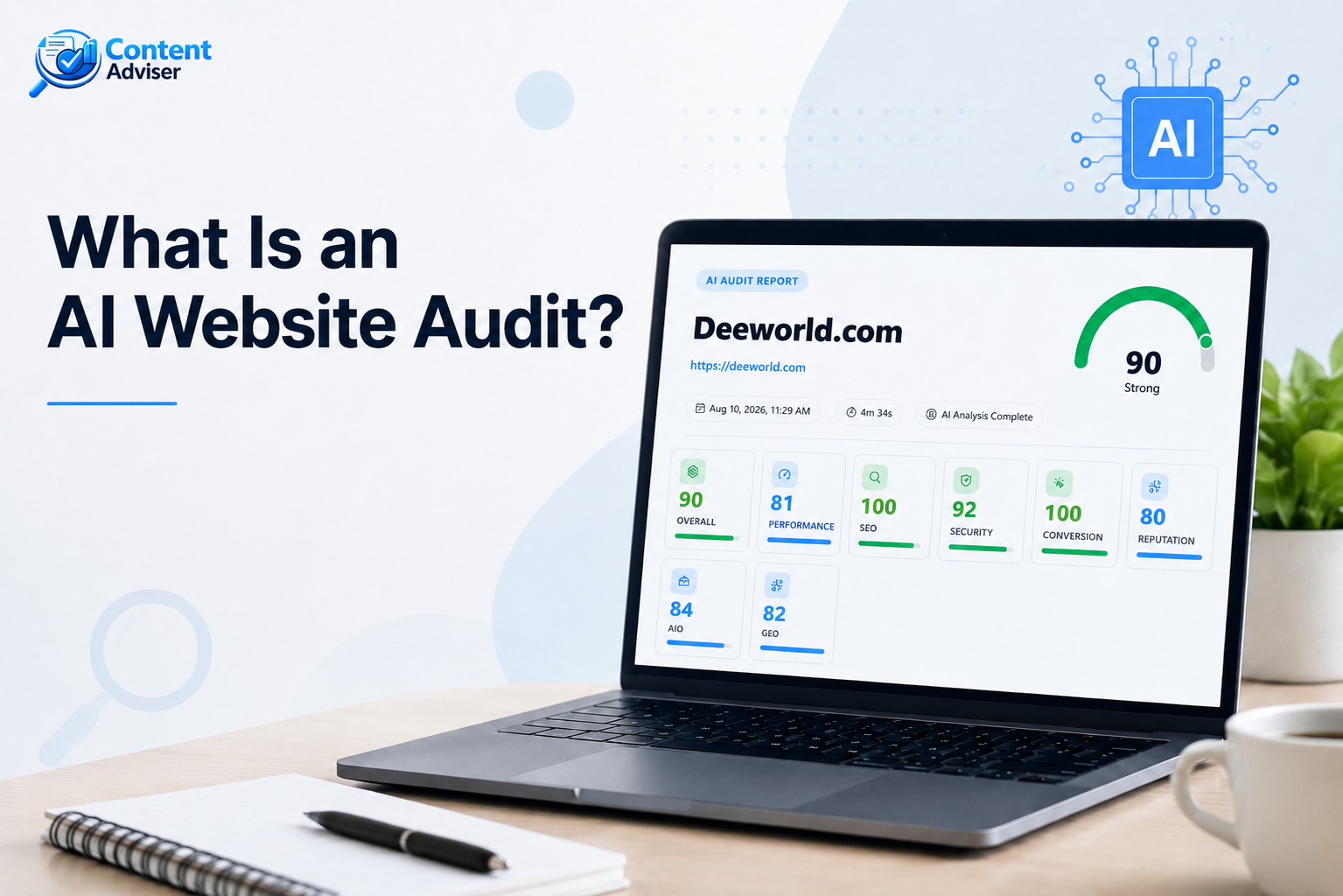
In today's highly competitive digital landscape, mastering what is an ai website audit? is a vital prerequisite for driving sustainable organic search traffic, building brand authority, and converting web visitors into loyal customers.
Search engine algorithms most notably Google's AI-driven RankBrain, BERT, and MUM natural language models have evolved far beyond basic keyword matching. Today, modern search engines evaluate digital properties through a multi-dimensional lens that measures technical integrity, semantic topical depth, real world user experience signals, and robust security protocols. When your digital infrastructure or published content fails to satisfy these technical and structural standards, search engine crawlers de prioritize your web pages, causing organic impression metrics to stagnate and search rankings to drop.
Many digital growth managers, content strategists, and webmasters struggle with what is an ai website audit? because they rely on outdated SEO tactics, fragmented manual workflows, or reactive problem solving. True search optimization requires a proactive, data driven approach that systematically eliminates technical barriers, aligns content structure with authentic search intent, and maintains continuous site health. In this comprehensive 2026 guide, we explore everything you need to know about what an ai website audit is? breaking down core principles, technical execution, common industry pitfalls, and actionable strategies to help your domain dominate page one search results.
1. The Fundamental Role of SEO Integrity in Modern Search
To understand the true impact of what is an ai website audit?, one must examine how search engine bots crawl, render, and index web content across the global internet. Automated web crawlers (such as Googlebot) continuously scan billions of web pages, requesting HTTP resources, parsing HTML code, executing client side JavaScript, and following embedded hyperlinks. When a crawler encounters friction on your website such as slow server response times, unoptimized image assets, or broken redirect loops it expends finite computing resources and scales back your domain's allocated crawl budget.
Furthermore, modern search algorithms place heavy emphasis on user experience signals through frameworks like Core Web Vitals. If a user lands on your page from a search query and experiences sudden visual layout shifts, delayed interactivity, or thin text, they will bounce back to the search results immediately. This negative user behavior signals to search engines that your page failed to provide a satisfying user experience, resulting in direct ranking demotions across primary target queries.
Crawl Efficiency & Indexability: Streamlining bot access ensures newly published articles and product pages are indexed without delay.
Core Web Vitals & Loading Speed: Fast visual rendering builds user trust, reduces bounce rates, and improves organic search scores.
Topical Authority & Semantic Depth: Comprehensive topic coverage proves domain expertise to artificial intelligence search algorithms.
Mobile-First Architecture: Flawless responsive design ensures your site meets Google's primary indexing requirements.
2. Key Pillars & Implementation Strategies for What Is an AI Website Audit?
Successfully executing a strategy focused on what is an ai website audit? requires a structured framework that combines rigorous technical diagnostics with continuous on page optimization. Below are the foundational pillars required for long term organic growth:
Continuous Technical Auditing: Regularly scanning your domain to catch broken links, canonical errors, and code glitches before bots find them.
Semantic Intent Alignment: Structuring content around primary search keywords, related conceptual entities, and user intent nuances.
Performance Asset Optimization: Minimizing file sizes, leveraging modern image formats like WebP, and minifying CSS and JavaScript assets.
Strategic Internal Link Architecture: Distributing domain authority effectively from high power pillar pages to secondary supporting guides.
E-E-A-T Signal Integration: Demonstrating Experience, Expertise, Authoritativeness, and Trustworthiness through transparent author information and citations.
3. Common Mistakes and Technical Blockers to Avoid
Even seasoned marketing teams and web developers make costly errors when addressing what is an ai website audit?. Recognizing and preventing these common mistakes will save time, preserve crawl budget, and protect your organic traffic:
Treating SEO as a One-Time Event: SEO is a continuous process; annual or quarterly audits leave your site vulnerable to unexpected technical drift.
Over-Optimizing Keywords: Forcing repetitive phrases into copy violates natural language processing models and degrades human readability.
Ignoring Technical Debt: Allowing soft 404 errors, broken redirects, and outdated script libraries to accumulate drains domain performance.
Failing to Audit Mobile Configurations: Testing pages exclusively on desktop devices overlooks mobile rendering bugs that penalize rankings.
4. Streamlining Strategy & Maintenance with Content Advisor
Managing all of these technical and content requirements manually across an expanding website is a recipe for team burnout. Content Advisor eliminates this operational burden by delivering real-time, AI-powered website auditing and continuous site health monitoring. Content Advisor operates silently in the background, auditing your entire web infrastructure for issues related to what is an ai website audit?. Instead of overwhelming your growth team with raw, unfiltered error logs, Content Advisor categorizes technical glitches into clear, prioritized tasks ordered by business impact and expected ROI.
Operational Feature | Traditional Manual Process | Content Advisor AI Engine |
Execution Speed | Requires days or weeks of manual analysis. | Completes full site scan in seconds/minutes. |
Audit Scope | Limited to sampling a small subset of pages. | Analyzes 100% of domain URLs simultaneously. |
Diagnostic Precision | Prone to human error, typos, and missed code. | Algorithmic accuracy based on live search criteria. |
Actionability | Delivers dense, overwhelming spreadsheets. | Generates prioritized, step-by-step remediation plans. |
Monitoring Frequency | Periodic spot checks (quarterly or annual). | Continuous 24/7 real-time background auditing. |
5. Strategic 4-Step Implementation Action Plan for 2026
To achieve maximum organic reach and sustainable competitive advantage around what is an ai website audit?, follow this step-by-step execution roadmap:
Step 1: Perform a Comprehensive Baseline Audit — Launch an automated scan with Content Advisor to uncover current technical debt and crawl blockers.
Step 2: Resolve High-Priority Technical Blockers — Fix indexation errors, broken canonical tags, and severe Core Web Vitals issues immediately.
Step 3: Enhance Semantic On-Page Relevance — Expand thin content sections, integrate related entity keywords, and optimize visual readability.
Step 4: Enable Continuous Real-Time Monitoring — Set up automated background health tracking with Content Advisor to lock in page-one search positions.
So, mastering what is an ai website audit? is not an optional endeavor it is an absolute necessity for any brand or organization seeking to build a scalable, cost-effective organic search channel. By combining robust technical hygiene, deep semantic content optimization, and continuous real-time monitoring through Content Advisor, your website can systematically eliminate ranking obstacles, outpace industry rivals, and capture high-converting organic search traffic day after day.
Deep-Dive Frequently Asked Questions (FAQs)
To provide complete clarity on what is an ai website audit?, here are direct answers to the most common questions asked by founders, digital strategists, and webmasters:
Q: How quickly can I expect ranking improvements after optimizing for what is an ai website audit??
A: While technical fixes (such as resolving 404 errors or canonical issues) can yield crawling improvements within days, overall ranking gains typically materialize within 2 to 6 weeks as search bots re-crawl and re-index your updated pages.
Q: Why is automated auditing superior to manual spreadsheet reviews for what is an ai website audit??
A: Modern websites change constantly as new content is published and code is updated. Automated AI tools like Content Advisor detect broken links, speed drops, and indexing errors the instant they occur, preventing traffic losses before they happen.
Q: Does what is an ai website audit? directly impact my conversion rates and sales?
A: Absolutely. Optimizing technical speed, visual stability, and content relevance directly improves user experience, lowers bounce rates, and builds buyer trust, directly driving higher landing page conversion rates.
If this guide helped you sharpen your SEO strategy, make sure to like, subscribe, and follow for more tech and digital marketing tips!